

Healthy Foods To Lose Body Fat And Belly Flab
The older post on this page promised a list of healthy foods that melt belly flab. No single food does that. What the research on belly fat does offer is narrower and more useful: eating less overall comes first, and a handful of food choices have been linked with less belly fat. This article goes through the studies one at a time and then looks at where a sweet fruit like dates sits next to them.
This is general information, not personal medical or diet advice.
Belly fat and body weight are not the same measurement
Two of the studies below measure belly fat by scan and report two kinds separately: visceral fat and subcutaneous fat. Scan results do not always move together with the number on the bathroom scale.
A 2016 review led from Radboud University Medical Centre in Nijmegen pooled 117 studies with 4,815 people that measured visceral fat by imaging and tested either exercise training or a lower-calorie diet. Both approaches cut visceral fat. The diet produced the larger weight loss. Exercise showed a trend towards a larger drop in visceral fat, though that difference did not reach significance (P = 0.08).
The detail that matters for anyone hoping food alone will shrink the belly is this one. In studies where people did not lose weight, exercise was linked with a 6.1% fall in visceral fat, while diet showed virtually no change (1.1%). The authors also wrote that total weight loss “does not necessarily reflect changes” in visceral fat.
So food choices work on belly fat mainly by cutting calories. The NHS puts it plainly: “Most adults need to lose weight by eating fewer calories,” and its advice is to “eat less and be more active.”
Sugary drinks are the clearest swap
Of the single studies in this article (leaving aside the review), the sugary-drink trial is the only one that handed people the drink itself rather than advice. In a six-month trial at Aarhus University Hospital in Denmark, 47 overweight adults were each given one litre a day of a test drink: regular cola, semi-skimmed milk with the same calories, diet cola, or water. By the end, visceral fat had risen 24–31% more in the regular cola group than in the other three groups. Total fat mass was not significantly different between the four groups. The extra fat showed up in the belly, the liver and muscle rather than as a bigger overall total.
A larger observational study points the same way. In 1,003 adults from the Framingham Third Generation cohort in Massachusetts, abdominal fat was scanned twice, about six years apart. After adjusting for weight change, people who drank a sugar-sweetened drink every day gained an average of 852 cm³ of visceral fat over that time, against 658 cm³ in people who drank them less than once a month. Diet soda was not linked with any change in belly fat.
The NHS notes that a can of cola “can have as much as 9 cubes of sugar”, which is more than the daily limit it sets for adults. Its suggested swap is “water, lower-fat milk, or sugar-free, diet or no-added-sugar drinks.”
Whole grains in place of refined grains
At Pennsylvania State University, 50 adults with obesity and metabolic syndrome (25 men, 25 women) followed a diet cut by 500 kcal a day for 12 weeks. They were randomly assigned either to get all their grain servings from whole grains or to avoid whole-grain foods. Everything else in the advice was the same.
Both groups lost weight, waist size and percentage body fat. The whole-grain group had a significantly greater fall in the percentage of body fat in the abdominal region. That is one 12-week trial in which both groups were already eating less, so the grain swap sat on top of a calorie cut rather than replacing it.
The NHS gives a practical version of the same swap: wholewheat pasta, brown rice or potatoes with their skins on, which “contain more fibre than white or refined starchy carbohydrates and can help you feel full for longer.”
Soluble fibre and slower belly fat gain
The Wake Forest-led IRAS Family Study scanned the abdomens of 339 African American and 775 Hispanic American adults, aged 18 to 81, at the start and again five years later. Diet was recorded with a food questionnaire at the second visit, covering the previous year.
For each 10 g increase in soluble fibre intake, the rate at which visceral fat built up was 3.7% lower. Soluble fibre was not linked with any change in the fat under the skin. Activity mattered too: moderately active people had a 7.4% lower rate of visceral fat gain than less active people. This is an observational study. It shows a link, not that fibre caused the difference.
Where dates fit
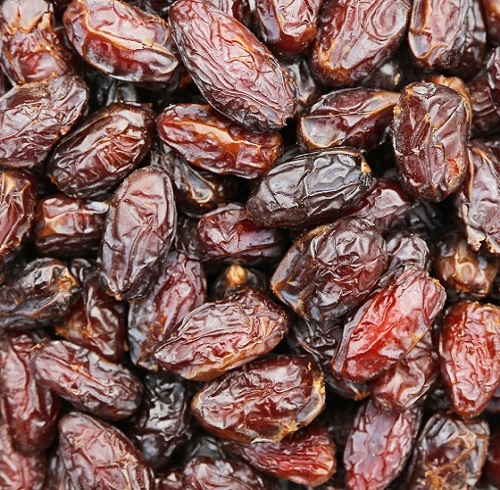
None of the studies above tested dates. The old post listed dates beside bananas, oranges and figs as something to eat instead of donuts and candy bars, so here is what the numbers say about them.
USDA FoodData Central lists Medjool dates at 277 kcal, 66.5 g of total sugars and 6.7 g of fibre per 100 g, and gives one pitted date as 24 g. That works out to roughly 66 kcal, 16 g of sugars and 1.6 g of fibre a date. FoodData Central gives total fibre for this record and does not split it into soluble and insoluble, so the soluble-fibre finding above cannot be applied to dates directly.
The sugar point is where dates and the drinks research meet. The NHS says sugar in fruit “is not considered free sugars unless the fruit is juiced or puréed.” A whole date eaten as a fruit falls on the other side of that line from a can of cola. Blend dates into a smoothie, though, and the NHS counts the sugar in it as free sugar, the same category as the drinks in the Aarhus and Framingham studies.
At about 66 kcal each, dates also add up quickly for anyone eating fewer calories, which, going by the Nijmegen review, is the step that moves belly fat when diet is the tool. A couple of whole dates in place of a sweet snack fits the advice above. A handful on top of everything else does not.
The original post also linked to Kurma Harga, and that link stays here.
Putting the studies together
In the Nijmegen review, diet moved visceral fat through weight loss, and exercise did more for it in the studies where weight did not change. The trials and cohorts here add some detail on what to eat. Regular cola raised visceral fat against milk, diet cola and water. Whole grains brought a greater fall in the percentage of abdominal body fat than refined grains inside the same calorie cut. People eating more soluble fibre gained visceral fat more slowly. None of these studies showed any single food burning belly fat on its own.
More about this site is on the about page and the contact page.